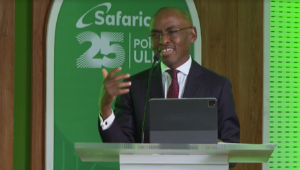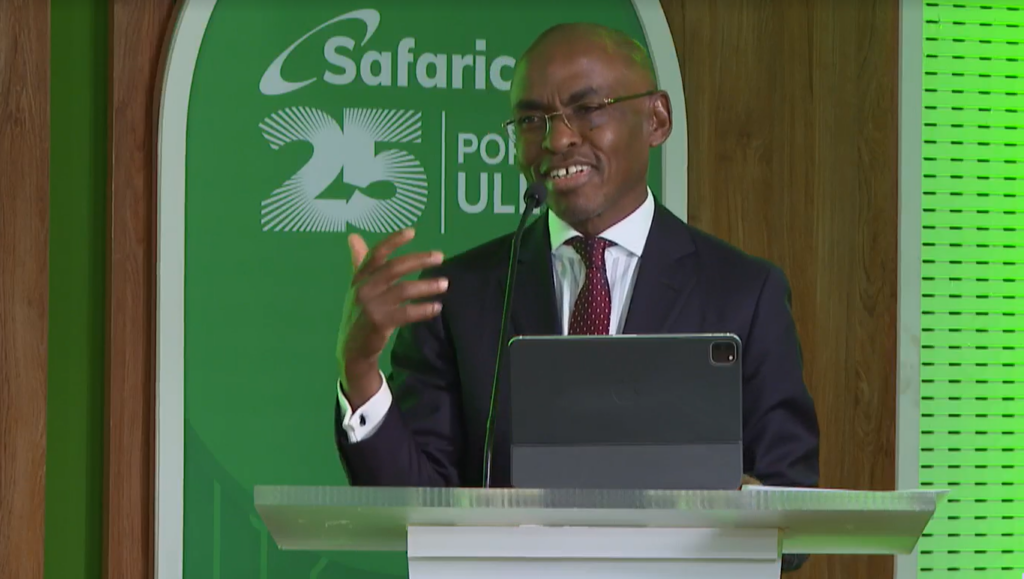
Safaricom CEO Peter Ndegwa speaking during the launch of Safaricom's 15th Sustainable Business Report. Photo/courtesy.
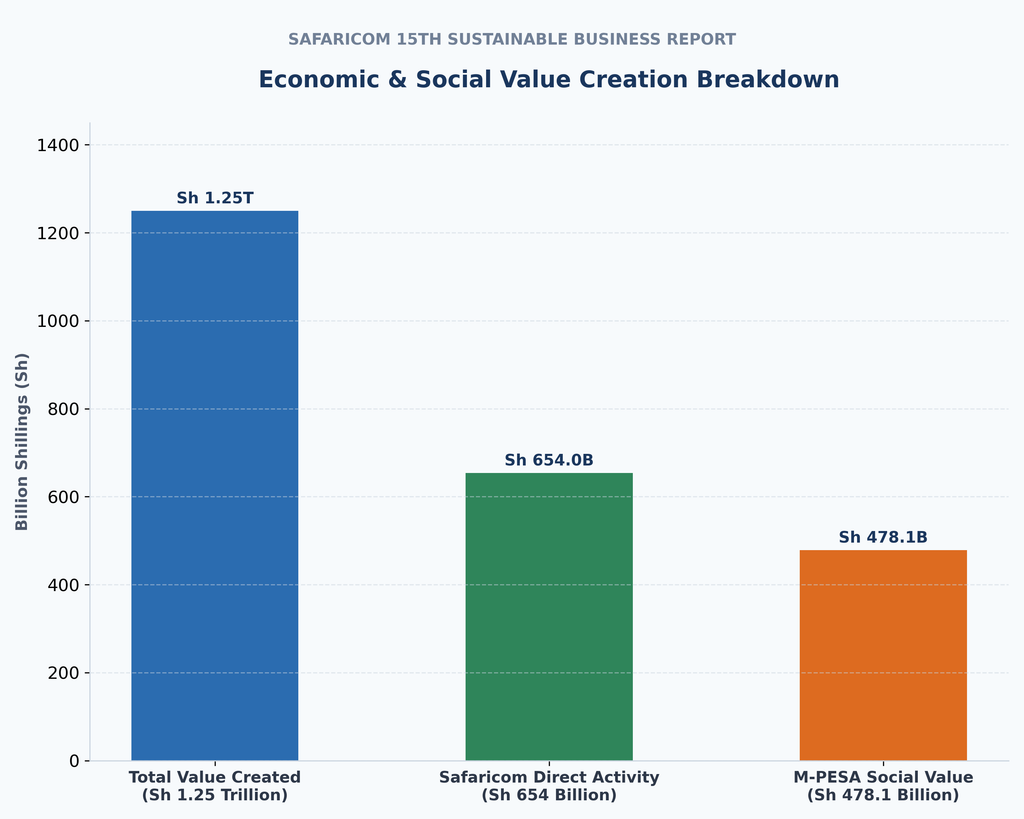
Safaricom launched its 15th Sustainable Business Report at the Michael Joseph Centre in Nairobi on Tuesday, under the theme “Rooted in Impact, Connecting the Future,” reporting Sh1.25 trillion in value created for Kenyan society in the year to March 2026, a 10% increase from the previous year.
Group CEO Peter Ndegwa said the report reflects how far the company’s sustainability reporting has evolved since it began in 2012 with a commitment to the UN Global Compact, and that sustainability now sits at the centre of how the business operates rather than alongside it.
“Sustainability cannot sit alongside the business, it has to be how we do business,” he said. He summed up the principle guiding that shift as “purpose before profit and reputation before revenue.”
Dr. Festus Ng’eno, Principal Secretary at the State Department for Environment and Climate Change, spoke at the launch on behalf of government, linking the report’s theme to Kenya’s own development priorities. He said sustainable growth has to be grounded in local communities even as the country pursues digital transformation.
“To be rooted acknowledges that sustainable growth must be anchored in the soil of our communities, our ecosystem and our national heritage. To be connected to the future reminds us that digital transformation and technological innovation are required to navigate global environmental disruptions,” Ng’eno said.
He also highlighted Safaricom’s early-warning messaging as a concrete example of that connection, citing the scale of SMS alerts the company has sent to farmers and pastoralists ahead of extreme weather events, as well as its broader role in green fintech, clean cooking, carbon credits and insurance products for drought-hit communities.
“Safaricom has been a vocal ally and partner in this, sending over 70 million SMS alerts to communities around the country,” he said.
For the first time, Safaricom applied a double materiality approach in the report, assessing both how its operations affect people and the environment and how sustainability risks, from climate change to fraud and cybersecurity, could affect its own long-term resilience. More than 40 material topics were identified and grouped under five pillars: building trust in the digital economy, connecting people and communities, empowering its people, protecting the planet, and leading responsibly.
The company also said it has retired the KPMG True Value model it used for a decade in favour of the Value Balancing Alliance methodology, which it says allows cleaner benchmarking against global peers, as it works toward full alignment with the IFRS S1 and S2 sustainability disclosure standards by FY28.
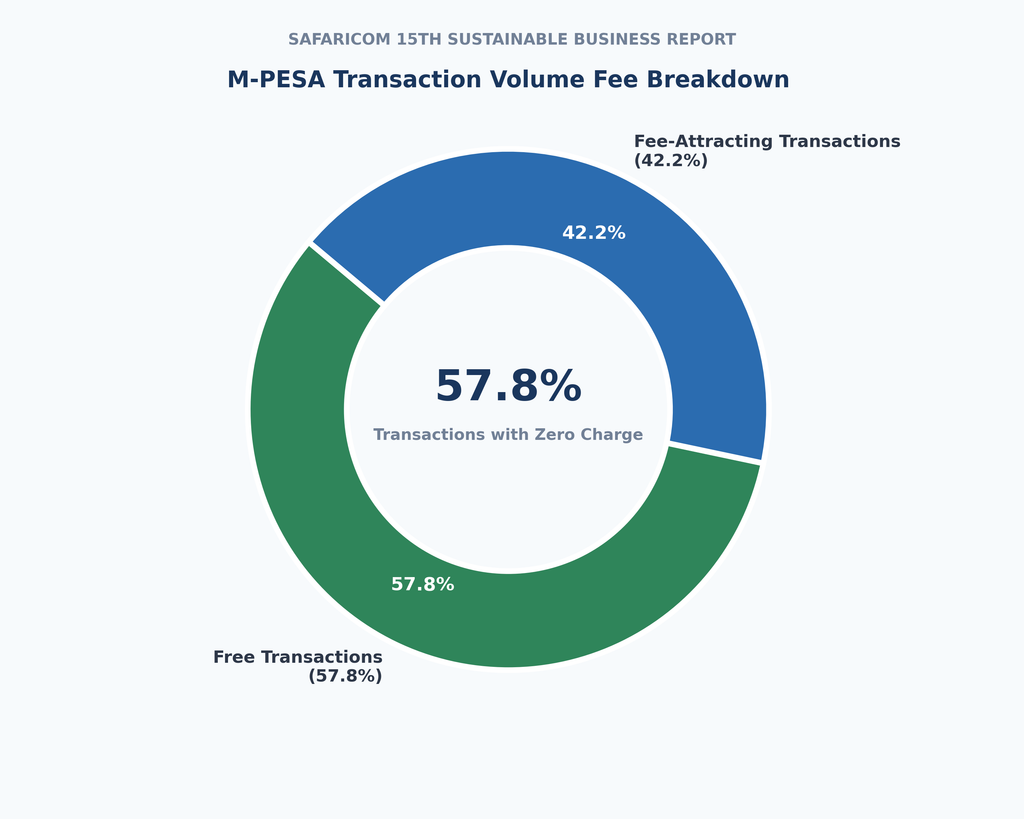
Of the total value created, Sh654 billion came directly from Safaricom’s own business activities, while the wider ecosystem of M-PESA agents, dealers, suppliers and other partners sustained more than 1.4 million jobs, including 70,000 created during the year. Ndegwa framed that figure around affordability rather than revenue, pointing to the share of M-PESA transactions that cost customers nothing at all.
“Our impact is measured not only by what we earn, but by the value we create for society. More than half of M-PESA transaction volumes attracted no customer charge, helping millions of Kenyans transact affordably and participate in an increasingly digital economy,” he said.
M-PESA’s own social value was estimated at Sh478.1 billion, with 57.8% of its transactions carrying no fee during the year.
Safaricom also disclosed that it detected and monitored approximately 1.25 billion intrusion attempts during the year and investigated more than 130,000 security events, while privacy trust scores for M-PESA and Safaricom recovered to 70% and 61% respectively.
Ndegwa said the scale of that activity was shaping how the company thinks about its use of artificial intelligence going forward. “Our ambition must be to use technology responsibly, securely and inclusively, and increasingly to use AI for good,” he said.
The company’s contribution across nine priority UN Sustainable Development Goals was independently assessed at B+ under the Alexforbes Paragon SDG Impact Assessment, with A+ scores on SDG 9 (industry, innovation and infrastructure), SDG 10 (reduced inequalities) and SDG 17 (partnerships).
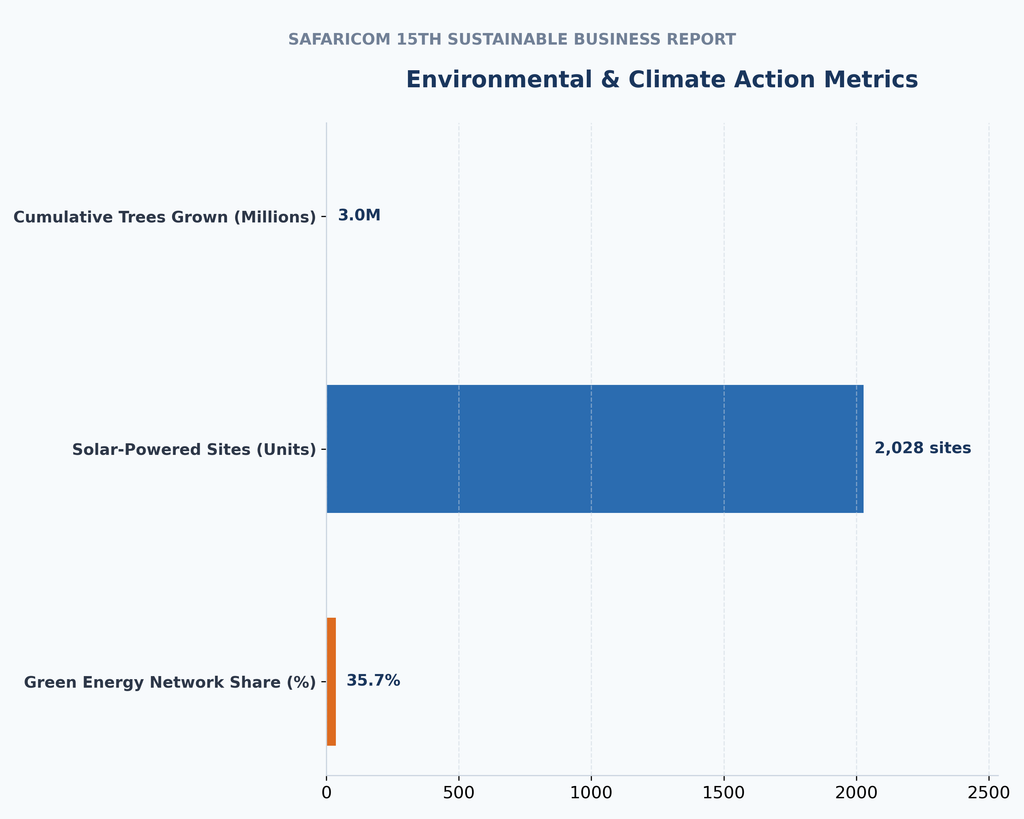
On the environmental side, Safaricom said it expanded its solar-powered network footprint to 2,028 sites, up from 1,432 a year earlier, against a long-term target of 5,000 sites, with 35.7% of the network now running on green energy. Its tree-growing programme added more than 600,000 trees during the year, taking the cumulative total past three million.
The company also disclosed that Scope 1 and 2 carbon emissions rose 9.1% to 56,354.12 tonnes of CO2e, and that it recorded one work-related fatality during the year despite its safety reset programme. Ndegwa acknowledged both as setbacks the company still needs to address.
“These are areas where we must do better, and where we remain committed to taking action and improving our performance,” he said.
Safaricom raised Sh20 billion through its debut green bond, part of a wider Sh40 billion domestic note programme, after applications worth Sh41.4 billion left the tranche oversubscribed by 175.7%. The company said it reached more than 4.4 million people during the year through Safaricom and M-PESA Foundation programmes spanning health, education, water access and economic empowerment, while women now hold about 44% of leadership positions, up from 24% when Ndegwa became CEO in 2020, against a 50% target by 2030.