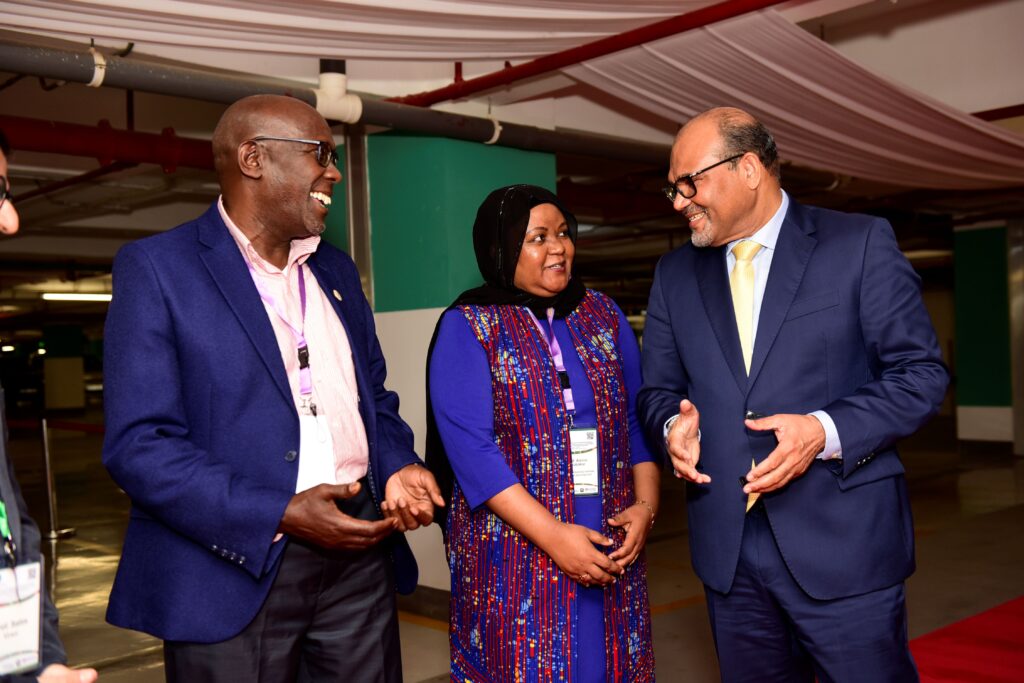
Prof. Shaukat Abdulrazak (R), Africa Foundation CEO Dr. Tom Kariuki (L) and Aga Khan University IHD Director Prof. Amina Abubakar during the University's IHD Conference. Photo/courtesy.
Africa is stepping up efforts to address a growing child development challenge through a new initiative aimed at strengthening brain health research and training a new generation of African scientists.
Experts meeting in Nairobi during the 10th anniversary celebrations of the Aga Khan University’s Institute for Human Development (IHD) warned that millions of children across Eastern and Southern Africa continue to face developmental delays and disabilities, yet the continent still lacks sufficient locally generated evidence and specialized neuroscience expertise to guide effective interventions.
Global estimates indicate that approximately 29 million children in Eastern and Southern Africa are affected by developmental disabilities and delays, underscoring the need for stronger investment in research and evidence-based solutions.
Speaking at the event, Prof. Amina Abubakar, Director of the Institute for Human Development at Aga Khan University, said research remains critical in identifying effective interventions that can help children reach their full potential.
“Every child deserves the opportunity to grow, learn and thrive. Investments in research allow us to understand local realities and generate evidence needed to improve child health and development outcomes,” she said.
The discussions highlighted concerns around child nutrition and its impact on brain development. According to the Kenya Demographic and Health Survey 2022, 18 percent of children under five are stunted while only 31 percent of children aged six to 23 months receive a minimum acceptable diet.
Researchers note that the first eight years of life represent a critical period for brain development, making early nutrition and caregiving essential for long-term learning and cognitive outcomes.
At the centre of current efforts is the Africa Leadership for Measuring Brain Health in Children and Adolescents (ALMA) consortium, an African-led programme launched in 2023 to strengthen neuroscience research capacity across the continent.
The consortium is currently training more than 50 early-career researchers from Kenya, Malawi, South Africa and Zambia to conduct locally relevant studies on child and adolescent brain development and mental health.
ALSO READ: The Aga Khan University Hospital Achieves Fifth Successive International Quality Accreditation
The initiative brings together leading institutions including Aga Khan University’s Institute for Human Development, the University of Cape Town, the University of Zambia and Kamuzu University of Health Sciences, alongside international collaborators such as the University of Oxford and Massachusetts General Hospital.
In Kenya, research supported through ALMA has contributed to the development of a Mental Health Literacy Toolkit for adolescents aimed at improving awareness of mental health conditions, reducing stigma and creating more supportive school environments.
Prof. Shaukat Abdulrazak, Principal Secretary in Kenya’s State Department for Science, Research and Innovation, emphasized the importance of scientific evidence in shaping public policy and development programmes.
“When we invest in research, we invest in better decisions. Evidence helps us understand what challenges communities face and which solutions are most likely to improve lives,” he said.
The initiative also builds on findings from studies conducted in Nairobi County that revealed persistent inequalities in school readiness and child development outcomes between informal and formal settlements. Researchers identified gaps in access to nurturing care, including early stimulation and responsive caregiving.
As African countries seek to improve education outcomes, workforce readiness and long-term economic growth, experts argue that strengthening child brain health research could play a significant role in unlocking human potential across the continent.
ALMA is funded by the Science for Africa Foundation with support from Wellcome and the UK’s Foreign, Commonwealth and Development Office.