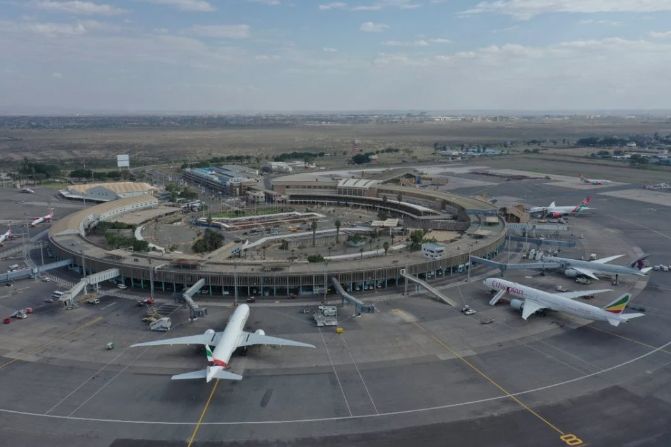
Jomo Kenyatta International Airport main terminus. photo/ courtesy
The government has announced an ambitious plan to construct a new airport terminal at Jomo Kenyatta International Airport (JKIA) and upgrade existing facilities, to address growing capacity constraints at the country’s primary aviation gateway.
The project, unveiled by the Ministry of Roads and Transport on Tuesday, March 3rd, 2026, comes in response to severe operational pressures at JKIA, which currently handles approximately 8.93 million passengers annually far exceeding its designed capacity of about 7.5 million passengers per year.
According to a comprehensive Feasibility Study completed in February 2026, JKIA faces multiple infrastructure bottlenecks that threaten its role as East Africa’s leading aviation hub. The assessment identified limited runway capacity, insufficient aircraft stands and apron sensify.
Passenger numbers are projected to surge from 8.93 million in 2025 to approximately 22.31 million by 2045, reflecting an overall growth rate of 4.6 per cent. Air cargo is expected to more than double, growing from 407,214 tons in 2025 to 860,400 tons in 2045.
To address immediate needs while preparing for long term growth, the Kenya Airports Authority (KAA) has outlined a phased development strategy focusing first on enhancing existing infrastructure before undertaking major expansion.
Near term interventions include upgrading the existing runway, developing a partial parallel taxiway to enhance airfield circulation and constructing two rapid exit taxiways and runway end exit taxiways to improve landing efficiency.
KAA also plans to reconfigure and selectively expand passenger terminal facilities, digitalize passenger processing systems and optimize vehicle parking facilities.
A new passenger terminal capable of accommodating an additional 10 million passengers per year, upgrade the taxiway system with new taxiways and aprons and develop essential support infrastructure including air traffic control, firefighting stations, cargo facilities and utilities.
Beyond aviation infrastructure, KAA intends to develop an Airport City and Special Economic Zone (SEZ) to position JKIA as a fully integrated aviation led economic hub. The SEZ is designed to support high value, time sensitive industries including air cargo logistics, agro processing, pharmaceuticals, light manufacturing and e commerce fulfillment.
The Airport City will complement this by accommodating commercial developments including business parks, corporate offices, hotels and convention facilities.
According to the ministry of roads and transport these developments are expected to generate significant employment and foreign investment while diversifying airport revenues and supporting the objectives of Kenya Vision 2030.
Cabinet Secretary for Roads and Transport Davis Chirchir emphasized the project’s national importance, stating that the government “is committed to transparent implementation of the project and will continue to keep stakeholders and the public informed as the project progresses.”