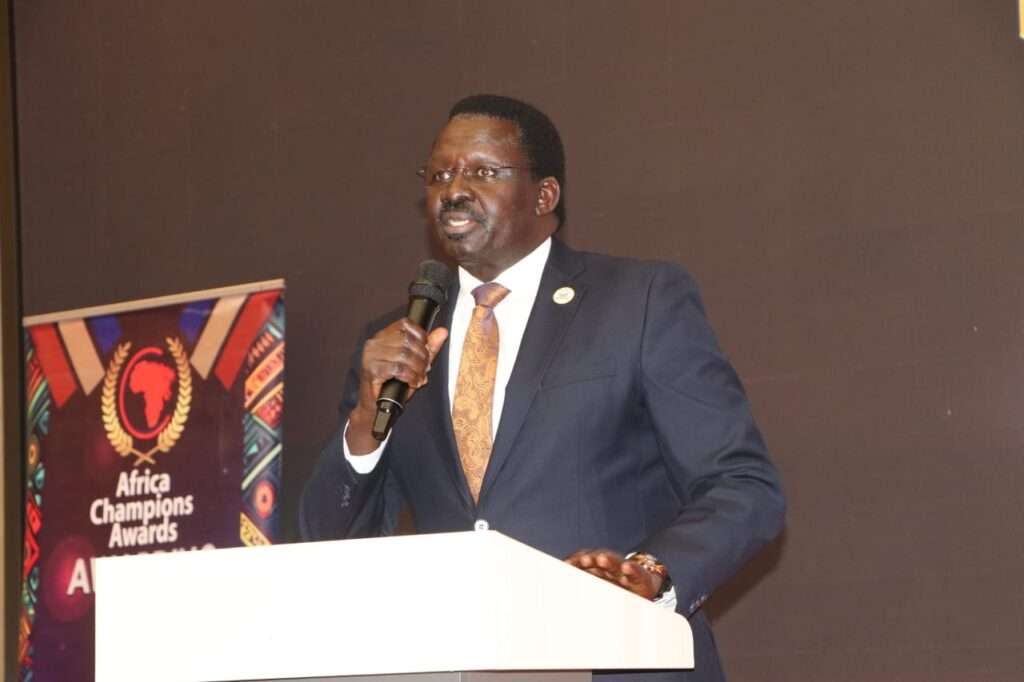
Kabarak University Vice Chancellor Prof Henry Kiplangat. Photo/Caleb Korir/JEDCA Media.
Kabarak University has been awarded as the best higher education institution of technology and research following its continued focus on innovation and market-driven teaching techniques by Africa Champions International Awards.
Speaking during the award ceremony held at Argyle Grand Hotel Nairobi, Kabarak University Vice Chancellor Prof Henry Kiplangat said the award came as a result of deliberate work of equipping learners with quality education and innovation.
Prof Kiplangat who doubles as Kabarak University CEO was also awarded as the best CEO in the country for his outstanding leadership, steering Kabarak into one of Africa’s top institutions of higher learning.
The university offers academic programmes across seven schools, including business, education, law, science and engineering, medicine and media. According to Prof Kiplangat, the institution focuses on innovation and problem-centered teaching curriculum and student-led innovation.
Innovation and Research
“We take research very seriously and our students have been encouraged to be innovators to solve some of the challenges we face as a country and as a continent. We have a student-led innovation center that has been recognized by Kenya National Innovation Agency (KNIA). Our students have won several awards in research and innovation,” Prof Kiplangat said.
ALSO READ: Job Market Shake-Up: Skills That Matter Most in AI Era
One of the university’s flagship innovations is an electronic voting system that students and staff jointly developed which allows learners to vote online from wherever they are. The system has been commercialized and currently being used by other universities to conduct student elections.
“Our students and staff innovated an electronic voting system. Every year when our students elect their leaders, they don’t do it face to face but they do it online from wherever they are. We have copyrighted the software and we have commercialized it. Other universities are paying Kabarak so that they can use our software to carry out elections,” he said.
Specialized Programmes
The university has introduced specialised programmes designed to address critical gaps in the health and technology sectors. Prof Kiplangat said Kabarak deliberately avoids duplicating programmes that already exist elsewhere, instead focusing on real-world problems and designing programs that address them. This includes a course on oncology pharmacy which helps fill the gap in cancer treatment among others.
“We are the only university that has an oncology pharmacy in Kenya. That is an important program that trains pharmacy professionals who will help in treatment of cancer. They fill a gap that was existing in the treatment of cancer in this country,” he said.
“We want to really solve the problems that are facing this country, for example in food security, where we do research that is meant to improve production of food so that we can become self-sufficient,” Prof Kiplangat added.
CBE-Compliant Programmes
Prof Kiplangat said that the institution’s programmes are competency-based education compliant which aligns with the current education system. He added that students undertake a lot of attachment to ensure that they are ready for the job market.
“Our teaching philosophy is problem-based. We want our students to research what they are doing and be involved in what they are doing so they learn by doing,” he says.
Prof Kiplangat further said that institutions should review the curriculum frequently to test its suitability in the market and to reflect current job market realities, including the use of AI and other new technologies.