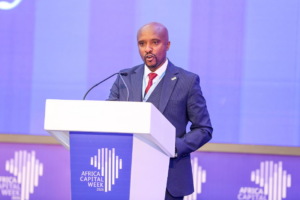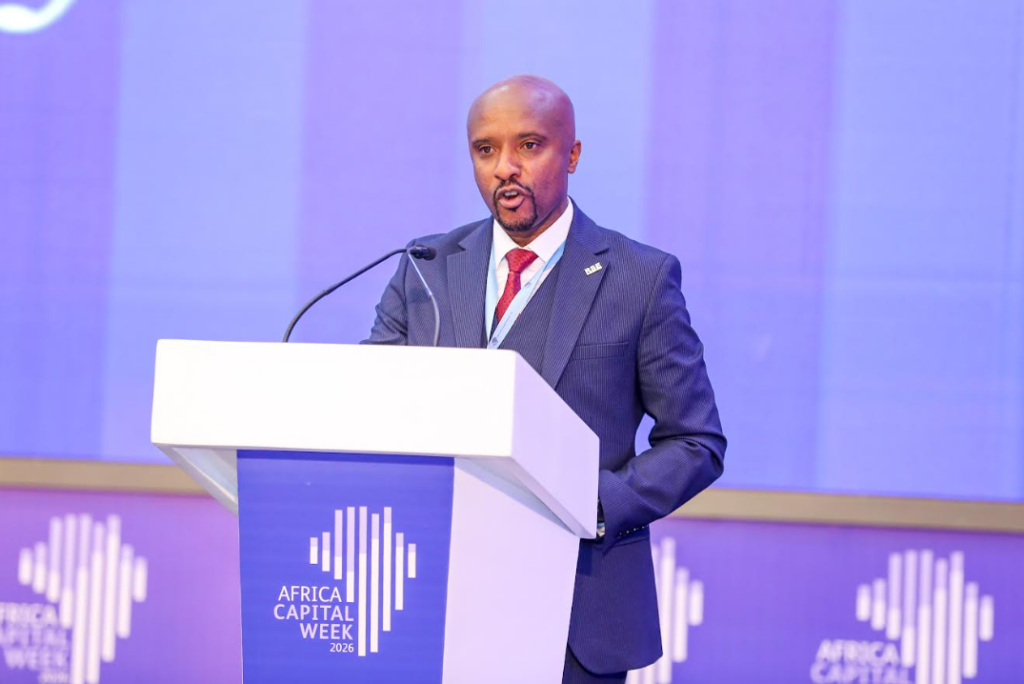
Pierre Celestin Rwabukumba, CEO or Rwanda Stock Exchange and President of African Securities Exchanges Association (ASEA), giving remarks during the official opening of Africa Capital Week 2026, which was held at Argyle Grand Hotel Airport in Nairobi. Photo/courtesy.
Africa’s capital markets agenda has taken a step towards greater integration after more than 500 delegates from 16 African countries and beyond adopted the Nairobi Declaration for Deepening Africa’s Capital Markets during the inaugural Africa Capital Week 2026 in Nairobi.
The declaration seeks to accelerate cross-border investment and strengthen Africa’s ability to mobilise and deploy capital towards its own development priorities.
The commitments focus on addressing regulatory and structural barriers that have made it difficult for capital to move efficiently between African markets.
Among the key proposals is the formation of an African Securities Regulators Association to support dialogue on cross-cutting regulatory issues and promote greater harmonisation of rules across markets.
Securities exchanges also committed to accelerating market interconnection through the African Securities Exchanges Association by using technology to improve connectivity between African exchanges.
Market intermediaries, through the Africa Stockbrokers and Securities Dealers Association, will also seek to expand intra-African securities trading as part of the wider effort to deepen continental investment flows.
The declaration further calls for greater mobilisation of Africa’s pension savings towards infrastructure through the accelerated formation of a Pan-African Infrastructure Fund.
Delegates also committed to engaging the African Union Commission on positioning capital markets as a key enabler of Agenda 2063 and identifying investment opportunities created by the African Continental Free Trade Area.
The commitments include efforts to remove unnecessary regulatory, tax, foreign exchange, settlement and administrative barriers that restrict the movement of capital while maintaining safeguards for financial stability and investor protection.
The forum also showcased 20 investment-ready projects covering energy, food security, transport, trade, technology, social infrastructure, minerals and private sector development.
Discussions focused on how these projects could attract financing through debt, equity, blended finance, guarantees and public-private partnerships.
Speaking during the closing ceremony, Principal Secretary for Economic Planning Dr Bonface Makokha said Africa must focus on turning development plans into projects that can attract investment and deliver measurable economic benefits.
“A development priority is not automatically an investible asset. We must convert our plans into credible projects, our projects into bankable assets, and our investments into measurable improvements in productivity, employment and household welfare,” said Makokha.
He said governments cannot finance every development priority but can create conditions that make African projects more attractive to investors.
“Government cannot finance everything. But Government can make much more of Africa financeable,” he said.
Makokha said the success of the commitments would ultimately depend on measurable outcomes such as capital mobilised, enterprises financed, projects delivered and jobs created.
The forum’s organisers said the Nairobi Declaration is intended to provide a structure for continued cooperation among governments, regulators, exchanges, financial institutions and investors.
Dr Emmanuel K Nzai, Chairman of the Vision 2030 Delivery Board and the Africa Capital Week 2026 Organising Committee, said the platform is intended to connect African capital with investment opportunities across the continent.
“The goal of Africa Capital Week is to establish the architecture that brings together Africa’s capital, institutions, and investment opportunities at scale, fostering the confidence and collaboration required to support Africa’s development priorities,” said Nzai.
He said the success of the forum would be measured by the partnerships created, resources mobilised and projects that advance following the Nairobi meeting.
Africa Capital Week will now become an annual continental platform hosted on a rotational basis across Africa.
The second edition is scheduled for Lagos, Nigeria, from 6 to 10 September 2027, with delegates positioning the event as an opportunity to assess progress on the commitments made in Nairobi.
The forum’s investment discussions will also continue through 11 September 2026, with delegations visiting Kenya Vision 2030 flagship projects and private sector investment sites to engage project sponsors on readiness, financing requirements, risk allocation and investment structures.