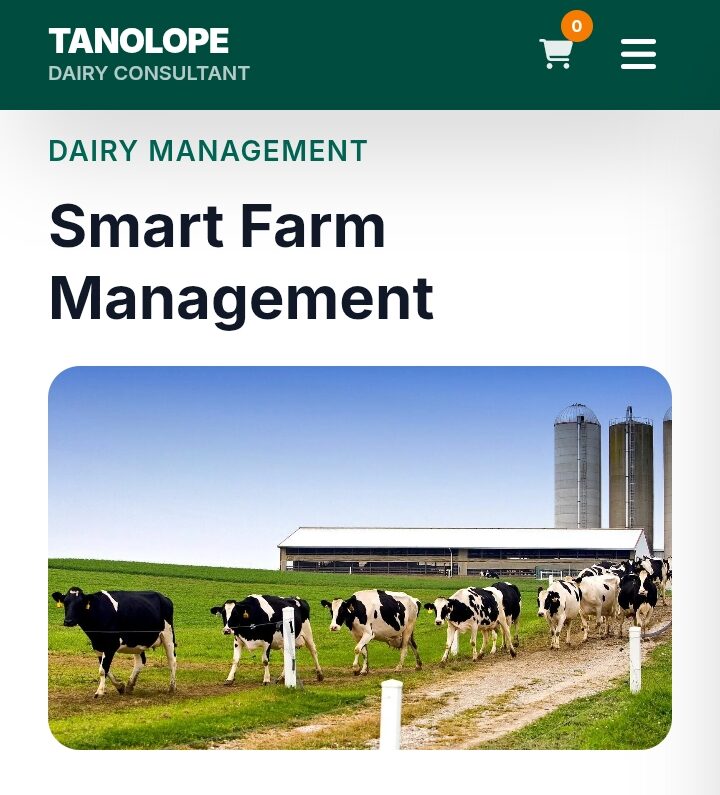
Tanodairy System. Photo/screengrab.
Africa’s dairy sector is expanding fast, yet productivity remains uneven. At the center of the challenge is dairy farm management. Millions of smallholder farmers produce milk, but fragmented systems, weak data, and inefficient market access continue to limit growth.
A new generation of digital infrastructure is beginning to change that. Platforms like TanoDairy, developed by Tanolope, are redefining what a modern dairy management system looks like by integrating farm operations, marketplaces, and financial tools into a single ecosystem.
The shift is not just technological. It is structural.
What Is Dairy Farm Management?
Dairy farm management refers to the systems used to oversee feeding, breeding, animal health, milk production, and farm finances to improve productivity and profitability.
Traditionally, these functions operate independently. Farmers rely on manual records, informal networks, and fragmented services. A modern dairy management system replaces this with coordinated, data-driven decision making.
The Fragmentation Problem in Africa’s Dairy Industry
Across many African markets, dairy operates in silos:
- Farmers manage herds manually
- Veterinary services are disconnected
- Input suppliers are hard to verify
- Milk buyers rely on informal sourcing
- Financial records are poorly maintained
This fragmentation increases:
- operational costs
- inefficiencies
- and lost revenue opportunities
The result is a system where production exists, but optimization does not.
Digital Platforms as Dairy Infrastructure
Platforms like TanoDairy are emerging as infrastructure layers rather than simple tools.
Instead of solving one problem, they integrate multiple functions into a unified dairy management system:
- Marketplace for farm inputs and services
- Herd and production tracking
- Veterinary and advisory access
- Training and best practice resources
- Financial records and transaction management
This model reduces friction across the entire value chain.
Search costs decline because farmers can find verified suppliers quickly. Transaction costs reduce as payments and orders move into a digital system. Trust improves through transparency and data records. In effect, digital platforms replace fragmented relationships with structured ecosystems.
Smart Farm Management Systems in Modern Dairy Farming
At the farm level, the impact of a dairy management system is immediate and measurable.
Digital tools enable farmers to:
- Track individual animal performance
- Monitor milk production trends
- Manage feeding schedules efficiently
- Record breeding cycles and outcomes
- Maintain health and vaccination data
This transition from guesswork to data-driven management improves decision making.
For example, when a farmer identifies a drop in milk yield early, they can adjust feeding or address health issues before losses escalate. Over time, these small optimizations compound into significant productivity gains.
Why Dairy Management Systems Matter for Farmers
The value of a dairy management system is not in the technology itself, but in outcomes.
Effective systems help farmers:
- Increase milk production through better feeding and monitoring
- Reduce costs by minimizing waste and inefficiencies
- Improve herd health with timely interventions
- Access better markets through structured platforms
- Build financial records that support access to credit
In markets where margins are tight, these gains are transformative.
Lowering the Cost of Dairy Business
Inefficiencies in dairy are often hidden in daily operations:
- Poor record keeping leads to financial leakages
- Middlemen increase marketing costs
- Lack of data limits financing options
- Weak coordination raises logistics expenses
Digital platforms like TanoDairy address these issues by embedding efficiency into the system.
By combining marketplace access, farm management, and financial tracking, a single dairy management system reduces the need for multiple intermediaries and disconnected tools.
This mirrors what digital platforms achieved in other sectors. They reduce the cost of coordination, which in turn improves profitability.
Instead of competing in conventional dairy production, the company is positioning itself as the digital backbone of the industry. This approach focuses on differentiation by creating entirely new market spaces rather than fighting for share in existing ones.
Africa produces over 50 million tonnes of milk annually, yet productivity per cow remains low. This gap represents opportunity and a scalable dairy management system can unlock efficiency across:
- farmers
- cooperatives
- suppliers
- processors
As more users join platforms like TanoDairy, network effects begin to emerge. Each participant increases the value of the ecosystem.
The Future of Dairy Farm Management
Globally, dairy systems are moving toward full digitization of the “farm-to-market” chain.
Advanced platforms integrate:
- data analytics
- supply chain coordination
- financial systems
- and real-time monitoring
In Africa, adoption is still early, but accelerating. The next phase of dairy growth will not be driven solely by increasing herd size. It will come from improving efficiency through better systems. A well-implemented dairy management system can deliver higher productivity without expanding resources.
FAQs
What is a dairy management system?
A dairy management system is a digital or structured approach used to manage farm operations such as feeding, breeding, milk production and finances to improve efficiency.
How do platforms like TanoDairy help farmers?
Platforms like TanoDairy connect farmers to suppliers, services and tools in one ecosystem, reducing costs and improving productivity.
Can digital systems increase milk production?
Yes. A well-used dairy management system helps farmers monitor performance, improve feeding, and detect health issues early, leading to higher milk yields.
Why is dairy farm management important in Africa?
Effective dairy farm management improves productivity, reduces inefficiencies and increases farmer income in a sector with growing demand.
The future of dairy in Africa will not be defined by isolated improvements, but by connected systems. Platforms like TanoDairy, built by Tanolope, signal a shift toward integrated, data-driven agriculture. The real transformation is not just digital but is operational. And it starts with how dairy farms are managed.